The Part Nobody Warns You About Loving More Than One Person
What poly grief actually feels like when the world assumes the math protects you.
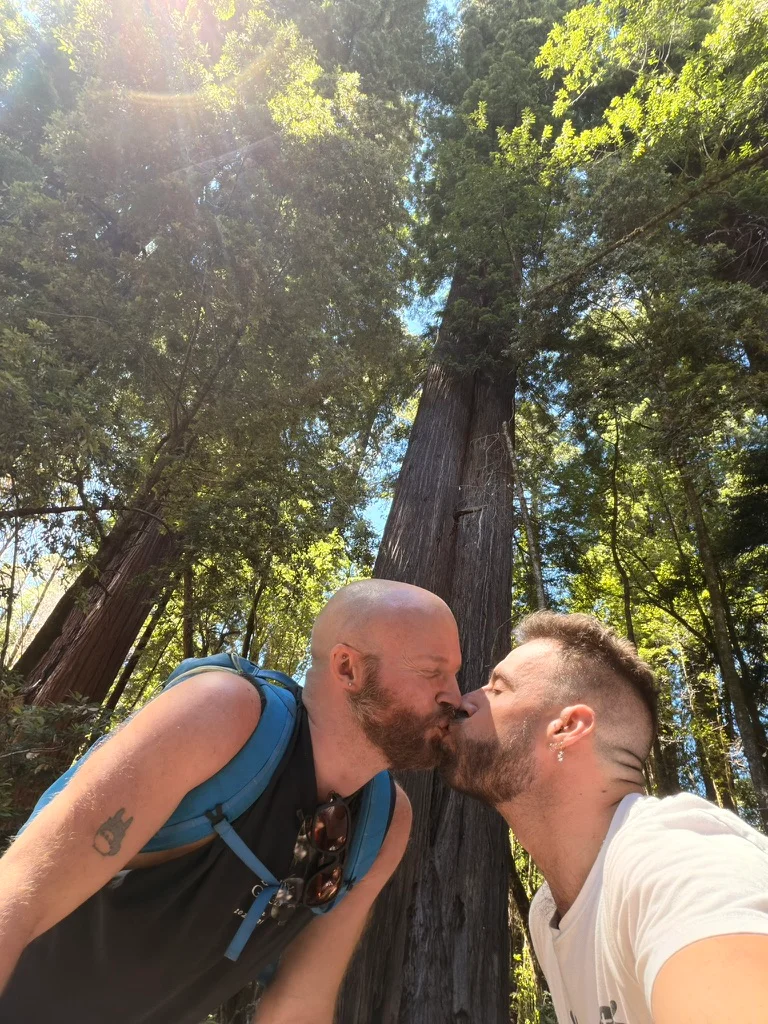
It's late. My partner is asleep in the next room, and I'm out here running the same equation I've been running for weeks. How do you grieve one person while you're still, completely, in love with another? Nobody hands you that worksheet. There's no card for it at the store. There's no casserole.
When you love more than one person, everyone assumes the math protects you. Like love is a redundancy system — one goes down, the other keeps you online. As if the person still here is a spare, and having a spare means you don't get to fall apart. That's not how it works. It was never how it worked. Losing him didn't leave me with "one out of two." It left me with a whole grief and a whole love, both at full size, both asking for all of me at the same time.
That's the part nobody warns you about.
There's a specific loneliness to grieving someone the world doesn't quite count. People understand a divorce. They understand a widow. They do not know what to do with a person who's wrecked over the ending of something they didn't have a word for. I've watched people's faces do the little calculation — but you still have someone, right? — like the person I still love is the answer to a math problem instead of a whole human being I love separately, on his own terms, for reasons that have nothing to do with anyone who left. Yes. I still have someone. That is not the same as being fine. Those are two different sentences and I need people to stop merging them.
And here's the confession I actually came out here to write: the hardest thing hasn't been the grief. It's been what the grief does to the love that stayed.
Because the person still here deserves my whole self. He deserves the version of me that's present, that laughs at the dumb thing he says, that notices when he's had a hard day before he tells me. And for a while there I kept handing him a version of me that was maybe seventy percent in the room. The other thirty was somewhere else, replaying a door closing. I'd catch myself doing it — being physically next to the person I've chosen, over and over, while my attention wandered off to mourn someone who chose differently. The guilt of that is its own second grief. You start to feel like you're cheating on the person who's still here with the ghost of the person who isn't.
I want to tell you I figured out how to stop. I didn't. What I figured out is smaller and truer than that.
Loving him all the way doesn't require me to be okay. I had the equation wrong. I kept thinking that to give him what he deserves I had to first be whole again, patch the hole, come back to him repaired. But that's not love, that's a delivery condition. What he actually deserves — what he's asked for, in his quiet way — isn't a fixed version of me. It's an honest one. He'd rather have me sad and real next to him than performing "fine" from behind glass.
So I stopped hiding the grief, and I stopped dumping it. There's a line between the two and I've had to learn to walk it sober. Letting him in sounds like I'm having a rough night, it's not about us, can you just be near me. It does not sound like making him hold the details of another relationship's ending, or asking him to reassure me about a wound he didn't cause and can't fix. He's my partner, not my grief counselor. Loving him well while I'm broken means being careful with what I ask him to carry.
Here's what I know now that I didn't a few months ago. Grief and love aren't drawing from the same account. Mourning someone I lost doesn't subtract from what I still have — I kept treating my heart like a checking account with a fixed balance, like every dollar spent missing one person was a dollar the other wouldn't get. That's not how any of it works. The heart is not zero-sum. I can be devastated and devoted in the same hour. I can cry about one person and mean it, and reach for another's hand in the dark and mean that too, and neither one makes the other a lie.
Choosing to stay in it isn't something that happened once. It's something I do on purpose, on the ordinary nights, especially the ordinary nights. It's making the coffee the way he likes it when I feel like making nothing. It's telling him the truth about where I am instead of ghosting him from inside my own home. It's letting the love I still have be enough to show up for, even when I'm grieving the love I don't.
It's late, and he's asleep, and in a minute I'm going to go get in bed next to him. Not because I'm healed. Because he's mine and I'm his and that's still true tonight, same as it was true before any of this, same as it'll be true tomorrow.
Grief doesn't care that I'm still in love. Turns out love doesn't care that I'm grieving, either. They're just going to have to learn to share the couch.
Share
Need care, testing, or support?
HIV and STI services nationwide
CDC information line
Planned Parenthood appointments
Los Angeles LGBT Center
Substance-use treatment and support
Mental-health crisis support
Follow That Slutty Nurse
For social pages, projects, and everything else that can't behave itself:
Medical disclaimer
This article shares sexual-health education, research summaries, and personal commentary. It does not provide individual medical diagnosis or treatment. Research findings and public-health recommendations may change as new evidence becomes available. Talk with a qualified healthcare professional about symptoms, testing, medications, prevention options, and decisions affecting your health.
Related reading
Milk Won't Save Your Friend
Somewhere along the way, the party community decided that milk and fatty foods were the cure for a G overdose. I did the research. That's not how any of this works.

The Study Didn't Even Ask About Meth
Last week I wrote about a San Francisco study that looked at how MSM and trans women perceive risk from substance use. It covered needle sharing, opioids, sex while under the influence. Solid research. But the researchers themselves flagged something I haven't been able to stop thinking about.

Clubs and Bathhouses Can Be Part of Public Health
A bowl of condoms does not create an orgy, just like a fire extinguisher does not create a kitchen fire.